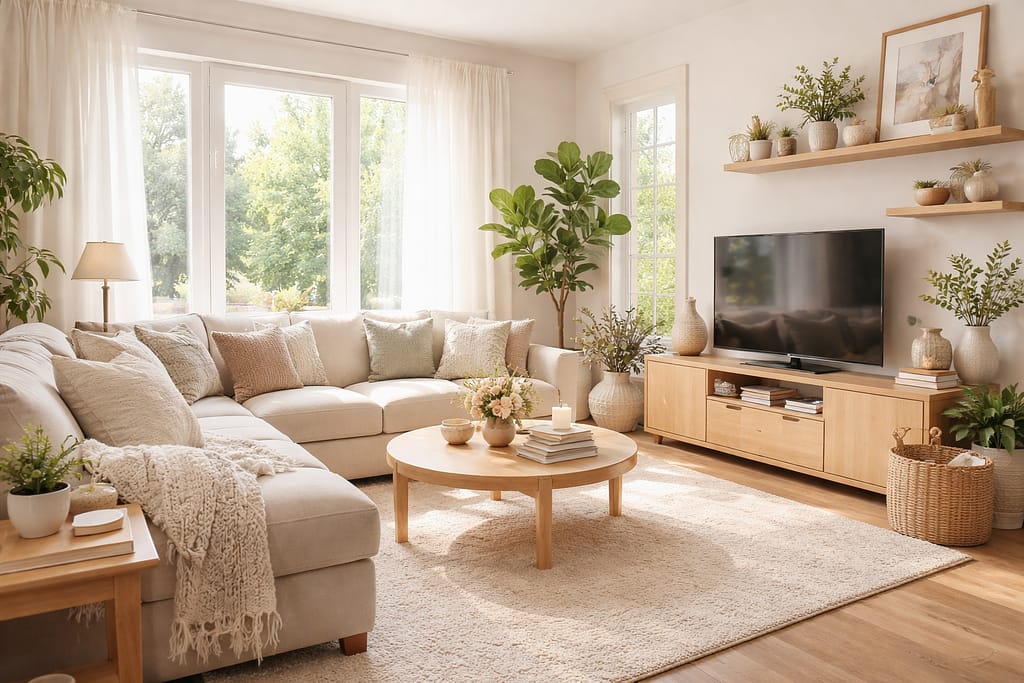
Designing a home often feels like a balancing act between “stark showroom” and “cluttered chaos.” To hit that sweet spot where a room feels both cohesive and curated, professional designers often lean on a secret weapon: the 70/30 Rule.
This simple ratio provides a blueprint for distributing color, texture, and furniture, ensuring your space has a clear identity without feeling overwhelming. Here is how to master this principle to transform your living space.
What is the 70/30 Rule?
At its core, the 70/30 rule is about visual hierarchy. It suggests that:
- 70% of the room should be dedicated to a “grounding” foundation—think neutral colors, large-scale furniture, and subtle textures.
- 30% of the room is your “personality” zone—this is where you introduce bold accents, intricate patterns, and statement pieces.
Think of the 70% as the canvas and the 30% as the art. Without the canvas, the art is a mess; without the art, the canvas is boring.
1. Master the Palette: Color Distribution
Color is the most immediate way to apply this rule.
- The 70% Base: Use calming, primary tones for your “big ticket” items like walls, flooring, and large rugs. Soft greys, warm beiges, or off-whites create a serene backdrop.
- The 30% Accent: This is your playground. Inject energy through cushions, throws, or a single feature wall. For instance, in an HDB flat in Bishan, a neutral sand-colored sofa (70%) becomes high-design when paired with vibrant emerald cushions and a brass floor lamp (30%).
2. Play with Texture and Pattern
A room with zero pattern feels flat, but a room with too much feels frantic.
- The 70% Foundation: Opt for “quiet” textures—linen curtains, smooth wood, or matte finishes.
- The 30% Contrast: Introduce tactile interest. A velvet armchair, a geometric rug, or a textured wallpaper adds depth. This 30% allows the eye to travel around the room and find “moments” of interest.
3. Furniture and Layout Strategy
The rule also helps prevent a room from feeling cramped.
- The 70% Anchor: Your heavy hitters—the sofa, the dining table, the bed frame—should be classic and functional.
- The 30% Flair: Use smaller pieces to make a statement. A sculptural side table or a vintage accent chair in a bold hue provides a focal point that doesn’t crowd the room’s flow.
4. Curating Art and Accessories
Accessories are usually where people accidentally flip the ratio, leading to clutter.
- The 70% Framework: Keep your surfaces and walls mostly clear or occupied by understated items.
- The 30% Highlights: Select a few high-impact pieces—a large-scale painting or a collection of ceramic vases. By limiting the number of “statement” items, you give each piece the “breathing room” it needs to be noticed.
5. Lighting as a Layering Tool
Lighting is the final touch in the 70/30 framework.
- 70% Ambient: This is your general illumination, like recessed ceiling lights or large floor lamps that fill the room with a steady glow.
- 30% Accent: Use task lighting or spotlights to draw the eye to your 30% “interest” zones—like a picture light over a favorite painting or a pendant light over a reading nook.
Creating a Whole-Home Narrative
The beauty of the 70/30 rule is that it can create “flow” throughout your entire house. By keeping a consistent 70% base (e.g., the same flooring and wall color) across all rooms, you can vary the 30% accent colors in each individual space. This makes the transition from the living room to the bedroom feel intentional rather than jarring.
Pro-Tip for Beginners: Start with a mood board. If your board looks 100% “exciting,” your room will likely feel exhausting. Aim for a board that feels 70% grounded and 30% inspired.